
CARE GUIDE
How to Clean a Cap Without Wrecking It
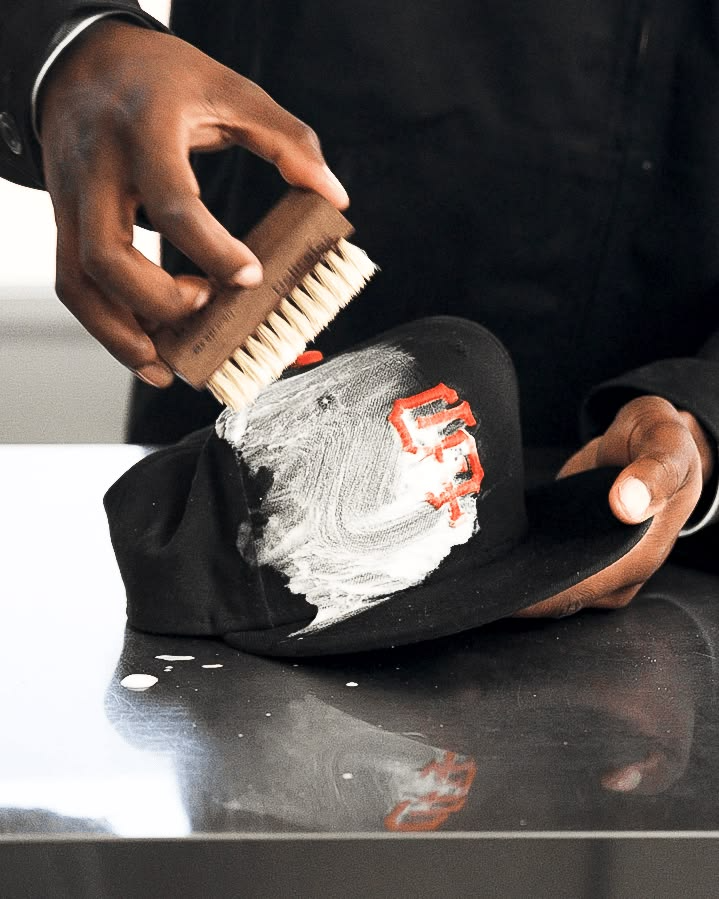
A cap gets more direct contact with skin than almost anything else in a wardrobe, and it never gets washed on the schedule that contact deserves. The reason is fear, mostly. People have seen what a washing machine does to a brim, so they do nothing at all until the sweatband has gone stiff and pale.
There is a middle path, and it takes about fifteen minutes of actual attention spread across a season.
Start With the Sweatband, Not the Crown
The band is where the problem always begins. Sweat carries salt, salt dries into the fibers, and the pale ring that appears along the inside edge is that salt sitting on the surface. Left alone it stiffens the band and starts to abrade the skin of your forehead.
Turn the cap inside out at the band, wet a cloth with cool water and a drop of gentle detergent, and work along the band in short strokes rather than scrubbing in circles. Rinse the cloth, go over it again with plain water to lift the detergent, and stop there. The band does not need to be soaked.
Spot Clean the Panels
Dirt on the outside of a cap is usually surface dust and the occasional mark, not deep staining. A soft brush takes the dust off dry, which is worth doing before any water is introduced, because wetting dust just spreads it into the weave.
For a mark, use the same cool water and a small amount of detergent on a cloth, working from the outside of the mark toward the middle so the edges do not spread. Blot rather than rub. Dark cotton twill can lose color under hard rubbing, and a faded patch is more visible than the original mark was.
Why the Machine Is a Bad Idea
Two things happen in a washing machine that a cap does not survive well. The drum flexes the brim repeatedly, which creases the core inside it, and once that core creases the curve never comes back symmetrically. Heat then shrinks the sweatband at a different rate than the panels, which pulls the crown out of shape.
Dishwashers get recommended online for the same job. The rack holds the brim flat, which solves the flexing problem, but the water is hot enough to cause the shrinking problem instead. Neither is worth the risk on a hat you like.
Drying Is Where Shape Is Won or Lost
A damp cap dried flat on a counter dries into the shape of that counter. Put it over something roughly head-sized instead: an upturned bowl, a rolled towel, a proper hat form if you own one. Leave it at room temperature and away from a radiator or direct sun, both of which dry the outer layer faster than the inner one and set a distortion in place.
Beanies are the opposite case. Knit stretches when it is wet and heavy, so a beanie goes flat on a towel rather than over a form, reshaped gently by hand while damp and left alone until dry.
Storage Between Wears
Hanging a cap on a hook by the closure puts all the tension on one point and slowly warps the back panel. Stack them crown-up on a shelf instead, or nest them loosely inside one another. Beanies fold flat and stack without complaint.
The one thing worth avoiding entirely is leaving a cap in a car through a summer. Heat inside a closed car reaches temperatures that soften a brim core, and a softened core takes on whatever shape it is resting in.
When Cleaning Is Not the Answer
A sweatband that has gone hard and glossy, or a brim already creased through the core, is past the point where cleaning helps. At that stage the hat is worn out rather than dirty, which is a different problem with a different solution.
If a cap arrived with a fault rather than earning one, that is covered on our Return & Refund Policy. If you are choosing your next one and want to know what actually holds up, the checks we use are described on our About Us page.
Thank you for shopping with us, and for keeping a good hat in regular rotation.